



“Chanukah” comes from the Hebrew word for “dedication.” Chanukah, also known as the “Festival of Lights” or the “Festival of Rededication,” is a joyous holiday that commemorates the rededication of the Second Temple in Jerusalem, and the miracle of the oil that lasted for eight days.


During the second century BCE, the Hellenistic Syrian-Greeks ruled the Land of Israel with an iron fist and tried to impose the Greek culture, beliefs, and practices upon the Jews. They robbed them of their property, outlawed Torah study, and made it illegal to keep the Torah commandments (such as Shabbat and circumcision). The Syrian-Greeks had ransacked the Holy Temple and desecrated it by using it for the worship of Greek gods and sacrificing pigs on the altar.
A small band of Jewish warriors, led by Judah Maccabee, the eldest son of the priest Mattityahu (Mattathias), decided to rise up and defend themselves. They defeated the mighty Syrian-Greek army and drove them from the Land, thus liberating it from foreign rule. In defeating the army, they were able to reclaim the Temple and rededicate it to the service of God.
At the time of the rededication, nearly all of the oil in the Temple had been contaminated by the Greeks. The Temple Menorah was supposed to burn continuously, day and night—and that’s why the oil was so important. Miraculously, the Maccabees found a jar filled with enough pure oil to last for one day. It would take eight days to obtain new, pure olive oil, but they went ahead and lit the Menorah anyway. By a miracle, the jar of oil they had found lasted for eight days and nights. Thus, the eight day Festival of Chanukah was declared in remembrance of this miracle.

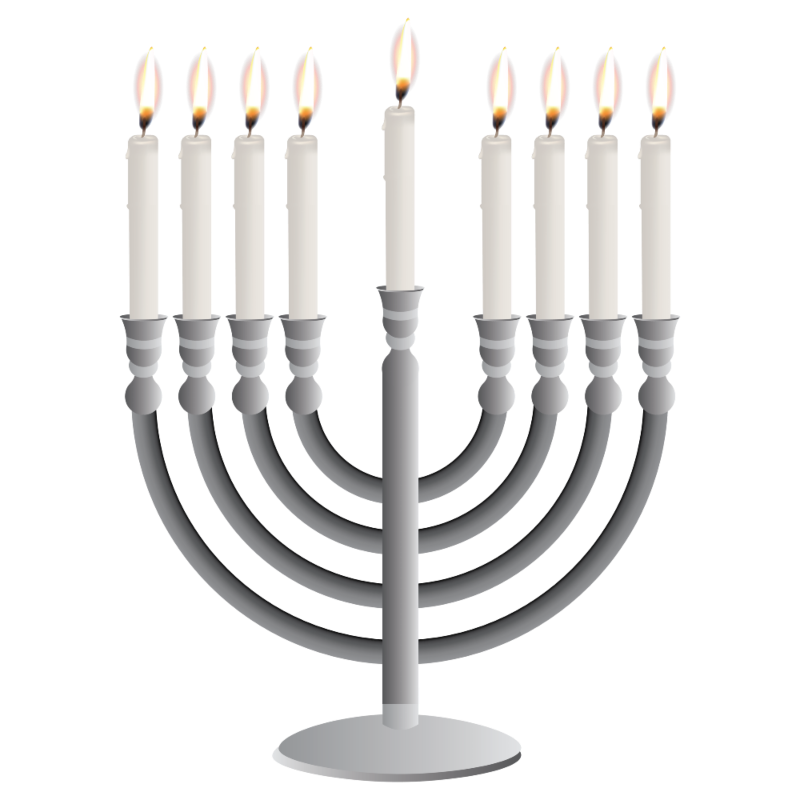
The Chanukah menorah, also known as a “chanukiah,” is an eight-branched menorah, with an additional branch called a shamash (“attendant”) which sits a bit higher or lower than the rest, and is used to light the other candles. The lights can be either candles or oil.
Every night of Chanukah, the Chanukah lights are kindled after sundown (except on Friday, the lights are kindled before sundown), after the appropriate blessings are recited. On the first night, as you face the chanukiah, set one candle in the far right branch and another candle for the shamash (the shamash is not counted as one of the regular lights). Use the shamash to light the first light.
Each following night, add another candle from right to left—then, use the shamash to light each candle from left to right. For example, on the second night, set two candles in the far-right branches, starting from right to left. Then, use the shamash to light the left-most candle first, and continue to the right.
After kindling the Chanukah lights, it is customary to take some time to sing traditional Chanukah hymns, play a game of dreidel, enjoy a hot plate of fried potato latkes or fried doughnuts (called sufganiyot), and share Chanukah stories with family and friends.
Light does more than just remove the darkness. The reason for light is to illuminate the darkness—to transform the darkness into light. The time of the Syrian-Greek rule was a very dark one. Yet that darkness was transformed into light when a small band of Jews had a miraculous victory over the most powerful army in the world. Then came the miracle of the oil—the miracle of light.
When the Maccabees were faced with darkness, they did not resign themselves to it. And neither should we. The Chanukah candles serve as a reminder that darkness can be won by light. So go ahead, light a candle and let your soul shine bright for the rest of the year by helping others who are in need, being patient and kind, living with joy, reaching out to others to encourage and strengthen them, helping the poor, visiting the sick, and standing up for what is morally and ethically right in your family, your business or occupation, and your community.
Although at times you may feel small compared to the world around you, just remember that even the smallest pinhole of light can completely change a realm of darkness.

It is customary to eat oily foods during Chanukah to commemorate the miracle of the oil. Most famous of these traditional oily foods are:
- Sufganiyot—fried, jelly-filled doughnuts. Depending on where you live, you might be used to getting a doughnut any time of the year; but in Israel, these delicacies only come around during the Chanukah season!
- Latkes—fried potato pancakes, usually served with applesauce and sour cream. If you want to get creative, you can use these tasty little fritters to make a grilled cheese! “Latke” is a Yiddish word. The Hebrew word for latke is levivah (plural: levivot).
Another Chanukah tradition is playing with the dreidel (sevivon in Hebrew). A dreidel is a spinning top with four sides, each side marked with one Hebrew letter:
- נ (nun)—which stands for nes (“miracle”)
- ג (gimel)—which stands for gadol (“great”)
- ה (hei)—which stands for haya (“happened”)
- ש (shin)—which stands for sham (“there”)
Altogether, the phrase reads Nes Gadol Haya Sham, meaning “A Great Miracle Happened There”—“There” referring to the Land of Israel. In Israel, the ש (shin) on the dreidel is replaced with a פ (pei), which stands for poh (“here”)—so the letters on the dreidel represent the phrase Nes Gadol Haya Poh, meaning “A Great Miracle Happened Here.” Most people play for pennies, nuts, or chocolate coins called gelt.

Chanukah is an eight-day celebration that begins on Kislev 25 on the Hebrew calendar (December 4, 2026, through December 12, 2026, beginning and ending in the evening).

Traditional greetings for this holiday are: Chanukah Same’ach (Happy Chanukah), Chag Same’ach (Happy Holiday), or Chag Urim Same’ach (Happy Festival of Lights).

Be sure to check your STBM emails for news and updates about local Chanukah events, such as our Annual Corporate Chanukah Celebration and Candle Lighting! Not getting STBM emails? Sign up for FREE today by CLICKING HERE.

Simchat Torah Beit Midrash® Community,
Many households all over the world are excited for this special week of Chanukah, each one having different ways they remember this important event in history. How do you celebrate? Ralph Messer and STBM would like to invite you to share your Chanukah experience with us this year!
Send us pictures of what you do for Chanukah as you celebrate each night, and your photo could be randomly selected to be in our yearly STBM Chanukah Remembrance Community Slideshow during our livestream and on our Facebook Page! Your picture can include (but is not limited to) any of the following:
1. Chanukiah (Chanukah menorah)
2. Latkes (potato pancakes)
3. Sufganiyot (fried, jelly-filled doughnuts)
4. Dreidels
5. Special Chanukah craft
Have fun and be creative! Please send all entries to chanukah@stbm.org and watch for them to be displayed. We’re excited to see what you have to share!

Pronunciation Guide for Transliterated Hebrew Words
| a | [a] as in arm |
| ai | [ai] as in Thailand |
| e | [e] as in red |
| ei | [ei] as in eight |
| i | [i] as in ski |
| o | [o] as in score |
| oi | [oi] as in oil |
| u | [u] as in rule |
| ui | [ui] as in gluing |
| ch/kh | [ch] as in the Scottish loch |
| g | [g] as in good (not as in giant) |
| tz | [ts] as in hats |
| ‘ | short “eh” or “uh” sound |
The Hebrew Scriptures in this text have been derived from the Westminster Leningrad Codex (WLC), and the English translation is based off of the JPS 1917 Tanakh.
Simchat Torah Beit Midrash®
