Torah Portion of the Week

Building Character through the Themes of the Weekly Torah Portion

Torah

Leviticus 16:1–18:30

Next Reading:

May 1, 2027

24 Nissan, 5787

Haftarah

Ezekiel 22:1–16

 וַיְדַבֵּר ה׳ אֶל־מֹשֶׁה אַחֲרֵי מוֹת שְׁנֵי בְּנֵי אַהֲרֹן בְּקָרְבָתָם לִפְנֵי־ה׳ וַיָּמֻתוּ׃

Vai-da-ber A-do-nai el–Mo-sheh a-cha-rei mot sh’nei b’nei A-ha-ron b’kor-va-tam lif-nei–A-do-nai va-ya-mu-tu.

And the Lord spoke unto Moses, after the death of the two sons of Aaron, when they drew near before the Lord, and died;

Leviticus 16:1

Acharei Mot means “after the death.” This portion details the rituals of Yom Kippur (Day of Atonement), the holiest day of the year. The Yom Kippur service was led by the High Priest who represented the whole of the Jewish people. He was the only person who could enter the Holy of Holies this one day of the year. There, he would pray on behalf of all of the Jewish people, and seek their forgiveness and atonement.

The Holy of Holies was the smallest, innermost, and most sacred chamber of the Holy Temple.

Yom Kippur is a day of fasting, prayer, introspection, repentance, forgiveness, and resolution. It is a day of spiritual cleansing; a day in which one is closest to God. Even though Yom Kippur is a solemn day, one also feels an undertone of joy knowing that God will forgive them and grant them a year of life, health, happiness, and opportunity.

On this day, the people drew near to God and acknowledged their mistakes and wrongdoings. They were confident in His unconditional, unfailing love, for He is the King who graciously pardons and forgives.

Don’t Mistake the Value of Mistakes

Mistakes are an inevitable part of human life. No one likes making them, and often it is hard to admit them. Yom Kippur is a set-aside time to admit those mistakes, and to learn the value of forgiveness. Recognizing and admitting your mistakes is not a means to imprison you with guilt, but rather to give you the opportunity to learn from them and become a better person. Mistakes don’t define you; they make you grow. In fact, there is much benefit that can be derived from mistakes. Here are just a few examples:

Mistakes can be used in a positive way to…

  • Inform us more about ourselves and our values.Help us make better choices.
  • Teach us more about others.
  • Teach us to value forgiveness.
  • Give us new insight and direct us to be more creative.
  • Help point us in the right direction.
  • Hold us back in areas where we need to slow down.
  • Speed up necessary change in our lives.
Take a moment to pause and reflect on the other benefits you can derive from your own personal experience when it comes to mistakes.

Are you ready to grow, improve, and become what you are really capable of being? One of the greatest catalysts for success is recognizing, admitting, and learning from your mistakes. Just remember, your mistakes are what make you an overcomer.
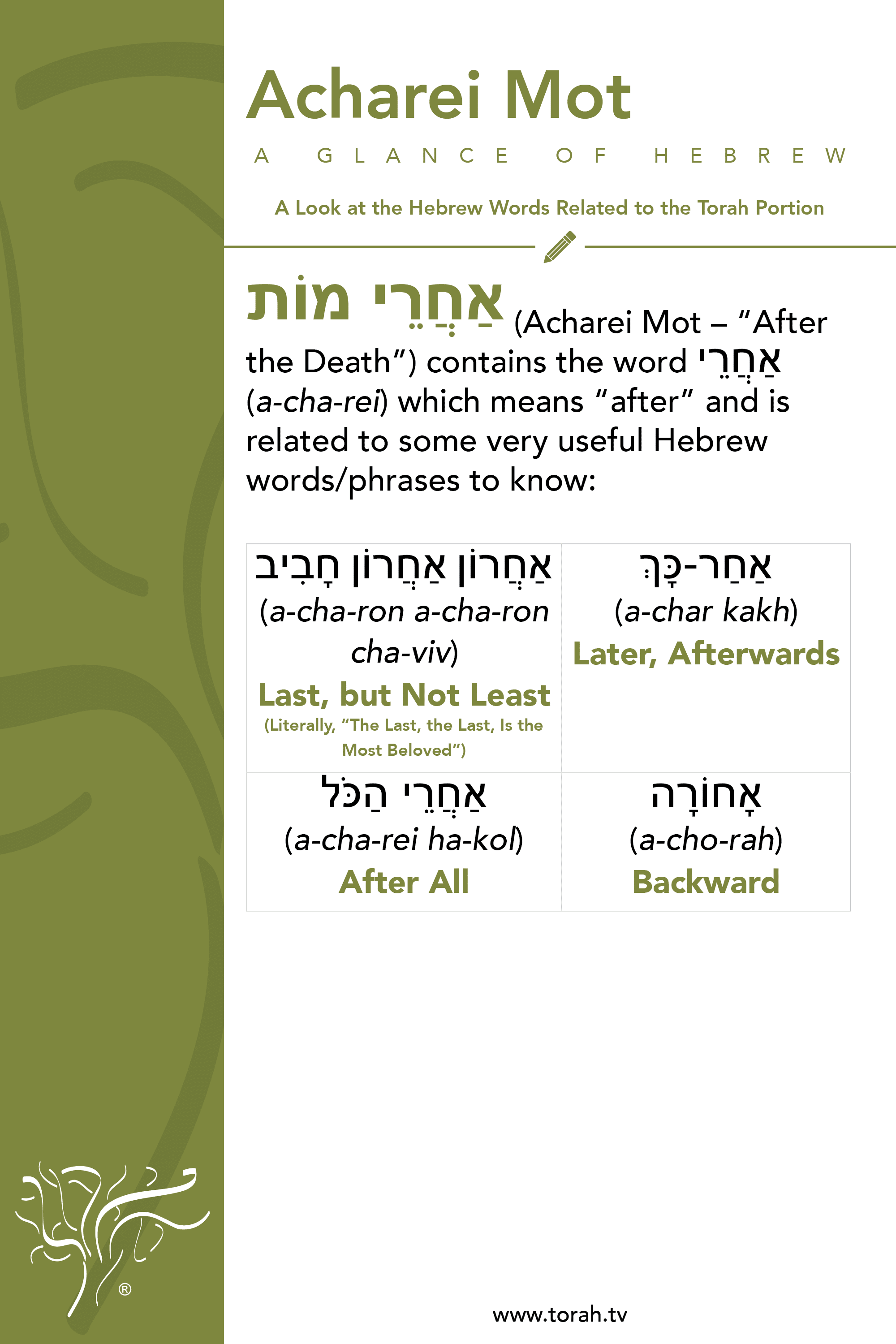
A Glance of Hebrew | Acharei Mot STBM Messer

Pronunciation Guide for Transliterated Hebrew Words

a

[a] as in arm

ai

[ai] as in Thailand

e

[e] as in red

ei

[ei] as in eight

i

[i] as in ski

o

[o] as in score

oi

[oi] as in oil

u

[u] as in rule

ui

[ui] as in gluing

ch/kh

[ch] as in the Scottish loch

g

[g] as in good (not as in giant)

tz

[ts] as in hats

short “eh” or “uh” sound

The Hebrew Scriptures in this text have been derived from the Westminster Leningrad Codex (WLC), and the English translation is based off of the JPS 1917 Tanakh.