Torah Portion of the Week

Building Character through the Themes of the Weekly Torah Portion

Torah

Deuteronomy 1:1–3:22

Next Reading:

August 2, 2025

8 Av, 5785

Haftarah

Isaiah 1:1–27

 אֵלֶּה הַדְּבָרִים אֲשֶׁר דִּבֶּר מֹשֶׁה אֶל־כָּל־יִשְׂרָאֵל בְּעֵבֶר הַיַּרְדֵּן בַּמִּדְבָּר בָּעֲרָבָה מוֹל סוּף בֵּין־פָּארָן וּבֵין־תֹּפֶל וְלָבָן וַחֲצֵרֹת וְדִי זָהָב׃

E-leh ha-d’va-rim a-sher di-ber Mo-sheh el–kol–Yis-ra-el b’e-ver ha-Yar-den ba-mid-bar ba-A-ra-vah mol Suf bein–Pa-ran u-vein–To-fel v’La-van va-Cha-tze-rot v’Di Za-hav.

These are the words which Moses spoke to all Israel beyond the Jordan; in the wilderness, in the Arabah, opposite Suph, between Paran and Tophel, and Laban, and Hazeroth, and Di Zahav.

Deuteronomy 1:1

Devarim means “words,” and is the name of this Torah portion, as well as the whole Book of Deuteronomy, the last of the Five Books of the Torah. The Book of Devarim differs from the first four Books of Moses. This Book was originally called by the Hebrew term Mishneh Torah meaning “a copy of the law” or “repeated law.” In fact, the term “Deuteronomy” is from the Greek deuteronomion meaning “second law.”

As a Father Carries His Son

In the portion of Devarim, Moses, shortly before his passing, recounted all of the Israelite’s travels through the desert, and chastised them for their behavior during those forty years. Nevertheless, he concludes by encouraging and comforting them as they are about to enter and conquest the land of Canaan. He reminds them not to fear their enemies, saying, “God will fight for you, just as He did in Egypt” (Deut. 1:30). He then comforts them by saying, “You have seen how the Lord your God carried you, as a man carries his son, in all the way that you have gone, until you came to this place” (Deut. 1:31).

As the Children of Israel were about to enter the Land, they knew that along the way, they would have to face and overcome some frightening enemies. God wanted to encourage them that He would always be there to help them and strengthen them. He had fought for them in Egypt, sustained them in the desert for forty years, and given them victory over their enemies along the way. He reminded them that He, as a Loving Parent, carried them as a father carries his son, and brought them all the way to the point where they were at.

Be strong and of good courage, fear not, nor be affrighted at them; for the Lord thy God, He it is that doth go with thee; He will not fail thee, nor forsake thee.

(JPS 1917, Deut. 31:6)

Let Him Carry You

Do you feel utterly alone? You are never alone because God is always with you, always present, and He will never abandon you. Do you feel afraid because of something you are going through? You have the capacity to have victory over every challenge that you face, because God is always near, always accessible, always a help in times of trouble. As the words of this Torah portion remind us: He is never absent, especially during the most lonely, fearful, and difficult times—and those are the times when He carries you as a father carries his son.

When loneliness or fear come your way, keep your thoughts positive, focusing on all of the victories God has given you. Watch wisely at what He is doing in your life during the difficult moments. Listen carefully to His words of encouragement: He will fight for you, and carry you through to the end.

God takes care of all of your needs, and He loves you as a father loves his child. He gives you so many reasons to trust and love Him. Whatever your situation, He is near, helping you to overcome all loneliness and fear.
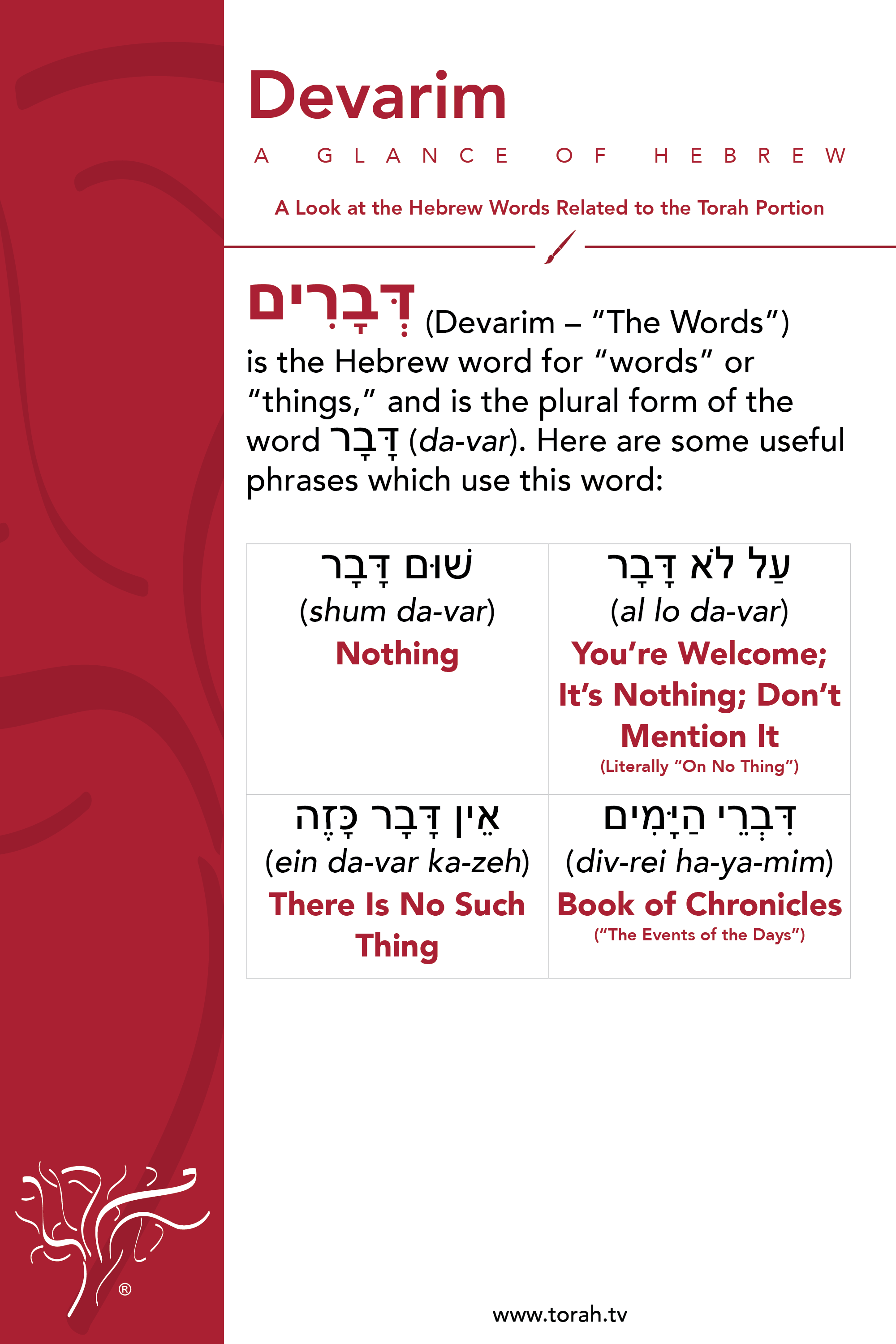
A Glance of Hebrew | Devarim STBM Messer

Pronunciation Guide for Transliterated Hebrew Words

a

[a] as in arm

ai

[ai] as in Thailand

e

[e] as in red

ei

[ei] as in eight

i

[i] as in ski

o

[o] as in score

oi

[oi] as in oil

u

[u] as in rule

ui

[ui] as in gluing

ch/kh

[ch] as in the Scottish loch

g

[g] as in good (not as in giant)

tz

[ts] as in hats

short “eh” or “uh” sound

The Hebrew Scriptures in this text have been derived from the Westminster Leningrad Codex (WLC), and the English translation is based off of the JPS 1917 Tanakh.