Torah Portion of the Week

Building Character through the Themes of the Weekly Torah Portion

  • Torah Portion Bamidbar STBM Messer

Torah

Numbers 1:1–4:20

Next Reading:

May 16, 2026

29 Iyar, 5786

Haftarah

1 Samuel 20:18–42

Shabbat Machar Chodesh

וַיְדַבֵּר ה׳ אֶל־מֹשֶׁה בְּמִדְבַּר סִינַי בְּאֹהֶל מוֹעֵד בְּאֶחָד לַחֹדֶשׁ הַשֵּׁנִי בַּשָּׁנָה הַשֵּׁנִית לְצֵאתָם מֵאֶרֶץ מִצְרַיִם לֵאמֹר׃

Vai-da-ber A-do-nai el–Mo-sheh b’mid-bar Si-nai b’O-hel Mo-ed b’e-chad la-cho-desh ha-she-ni ba-sha-nah ha-she-nit l’tze-tam me-e-retz Mitz-ra-yim le-mor:

And the Lord spoke to Moses in the wilderness of Sinai, in the Tent of Meeting, on the first day of the second month, in the second year after the exodus from the land of Egypt, saying:

Numbers 1:1

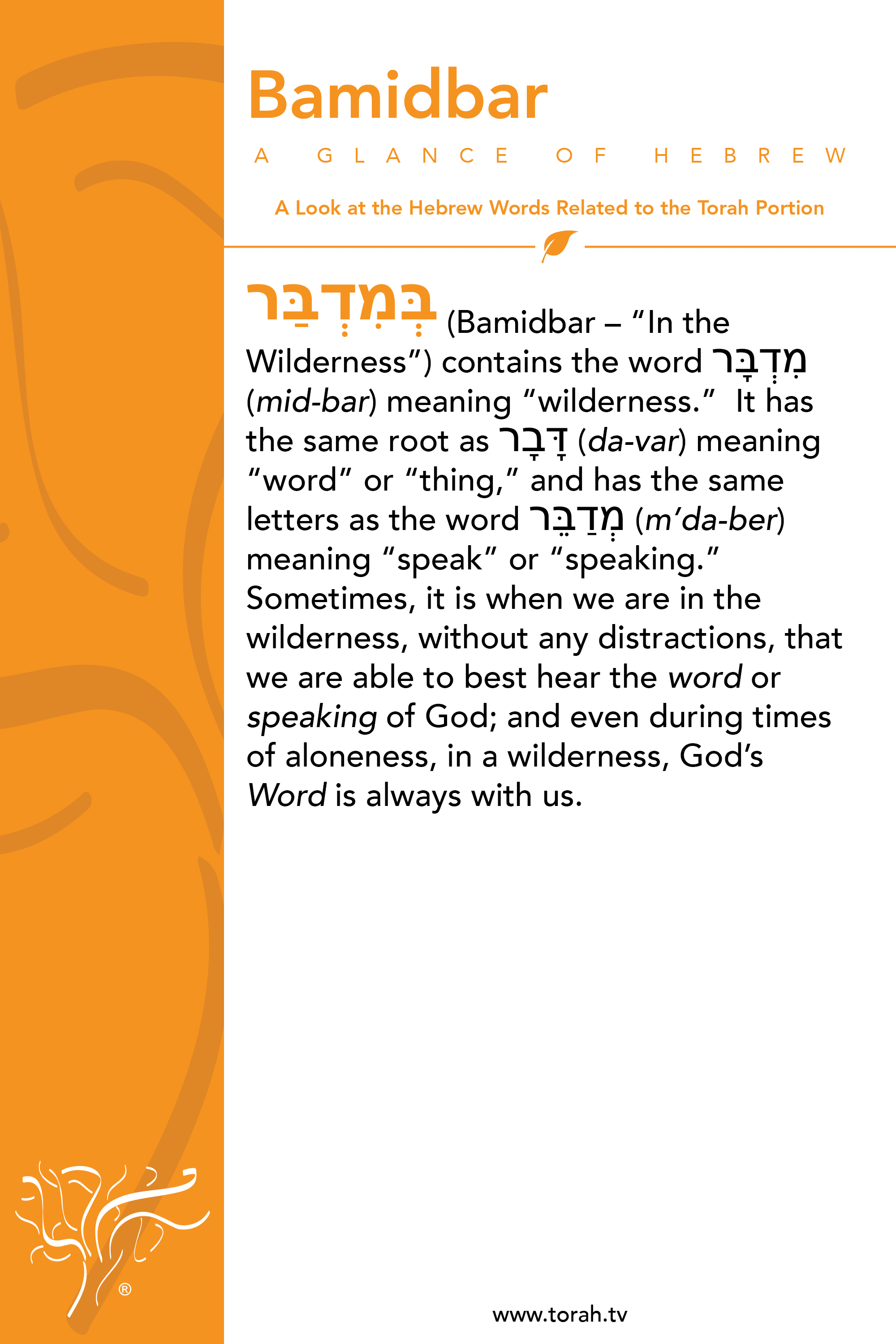
Bamidbar means “in the wilderness” or “in the desert.” This Torah portion is always read before Shavuot, the holiday which commemorates the Giving of the Torah at Mt. Sinai.

Bamidbar is not only the name of this Torah portion, but also the name of the whole Book of Numbers.

At the beginning of this portion, God commanded Moses and Aaron to take a census of the Twelve Tribes of Israel: “Take ye the sum of all the congregation of the children of Israel, by their families, by their fathers’ houses, according to the number of names, every male, by their polls;” (JPS 1917, Num. 1:2).

This was the third census taken after the Exodus from Egypt. What is special about this census is that it was not just a general census, but a census of each individual Tribe in which each person was counted by name, emphasizing and recognizing the individuality of every person who made up the entire community. Just as the community was important, so was the individual.

The Hebrew phrase used to describe the counting literally translates as “lift the head” (of all of the congregation of Israel)—further highlighting the worth and significance of each individual.

“Lifting up the head” of each individual ensures that each keeps his unique identity, and none is lost among the multitude.

Reuben — 46,500
Simeon — 59,300
Gad — 45,650
Judah — 74,600
Issachar — 54,400
Zebulun — 57,400
Ephraim — 40,500
Manasseh — 32,200
Benjamin — 35,400
Dan — 62,700
Asher — 41,500
Naphtali — 53,400

Total: 603,550 men of military age

The Levites were not included in this census, as they were to be “set aside” for other purposes.

God Is Counting on You

When a person knows that they matter, it gives them a source of self-confidence and self-esteem to be their best, to overcome the challenges they face, and to recognize their individual purpose and succeed in it.

You have a unique identity. You are here for a reason. Your role—great or small—counts, and is needed to contribute to the collective whole. It takes each grain of sand to make a beach. It takes each blade of grass to make a field. In God’s eyes, we are equally valuable, we all count, and we all have a job to do. Your greatness and self-worth are not determined by the opinions and observations of others. You matter just as much as everyone else, which is why you should never belittle yourself.

Every person counts and every person makes a difference. Never underestimate the importance of every single person in your life—including yourself. This week, take time to not only recognize your unique, individual role, but also the valuable role that everyone around you has to play, too.
A Glance of Hebrew | Bamidbar STBM Messer

Pronunciation Guide for Transliterated Hebrew Words

a

[a] as in arm

ai

[ai] as in Thailand

e

[e] as in red

ei

[ei] as in eight

i

[i] as in ski

o

[o] as in score

oi

[oi] as in oil

u

[u] as in rule

ui

[ui] as in gluing

ch/kh

[ch] as in the Scottish loch

g

[g] as in good (not as in giant)

tz

[ts] as in hats

short “eh” or “uh” sound

The Hebrew Scriptures in this text have been derived from the Westminster Leningrad Codex (WLC), and the English translation is based off of the JPS 1917 Tanakh.