



“Shemini Atzeret” literally means “Eighth Day of Assembly.” (See Lev. 23:36.) It has been said that, after the many days of celebration, Shemini Atzeret is God’s way of saying, “I have enjoyed this time with you so much. Please stay with Me one more day.”
Shemini Atzeret marks the beginning of Israel’s rainy season, and, appropriately, is the time when we begin to pray for rain. The special prayer for rain is called Tefilat Geshem. We continue to pray for rain after Shemini Atzeret by incorporating the phrase “He makes the wind blow and makes the rain descend” into the prayer of the Shemoneh Esrei (“Eighteen” blessings) until the first day of Pesach (Passover).

Outside of Israel, Shemini Atzeret/Simchat Torah begins the evening of October 2, 2026, and ends the evening of October 4, 2026 (Tishrei 22–23 on the Hebrew calendar), with Shemini Atzeret being on the first day, and Simchat Torah being on the second day. Within Israel, Shemini Atzeret/Simchat Torah begins the evening of October 2, 2026, and ends the evening of October 3, 2026 (Tishrei 22).

A traditional greeting for this day is: Chag Same’ach (Happy Holiday)!

36. Seven days ye shall bring an offering made by fire unto the Lord; on the eighth day shall be a holy convocation unto you; and ye shall bring an offering made by fire unto the Lord; it is a day of solemn assembly; ye shall do no manner of servile work.



Simchat Torah means “Rejoicing in Torah” or “Joy of God’s Teaching and Instruction.” It is a joyous holiday in which we celebrate and express our love and adoration of the Torah and our commitment to study it. As seen in the name, this holiday celebrates the Torah; it celebrates both the completion and the beginning of the Torah reading cycle. As soon as we finish the last Torah portion in the Book of Deuteronomy, we proceed immediately, without a break, to the first Torah portion in the Book of Genesis. The Torah is read in a continuous cycle that is unbroken, like a circle that goes on forever, for eternity. Just as the Torah is eternal, the Almighty who gave us the Torah is Eternal.
The completion of the Torah reading cycle is a time of great joy and celebration, observed with dancing and clapping, singing and rejoicing. We celebrate by taking out all of the Torah scrolls from the Ark and carrying them around the bimah (table in a synagogue from which the Torah is read) seven times. This procedure is called hakafot, which literally means “encirclement,” and in some communities, this procedure is also done on the night of Shemini Atzeret.

Outside of Israel, Shemini Atzeret/Simchat Torah is celebrated as a two-day holiday immediately after Sukkot ends. The first day is called Shemini Atzeret and the second day is called Simchat Torah. In Israel, Shemini Atzeret and Simchat Torah are observed together as a one-day festival immediately after Sukkot ends.
Outside of Israel, Shemini Atzeret/Simchat Torah begins the evening of October 23, 2024, and ends the evening of October 25, 2024 (Tishrei 22–23 on the Hebrew calendar), with Shemini Atzeret being on the first day, and Simchat Torah being on the second day. Within Israel, Shemini Atzeret/Simchat Torah begins the evening of October 23, 2024, and ends the evening of October 24, 2024 (Tishrei 22).


A traditional greeting for this day is: Chag Same’ach (Happy Holiday)!

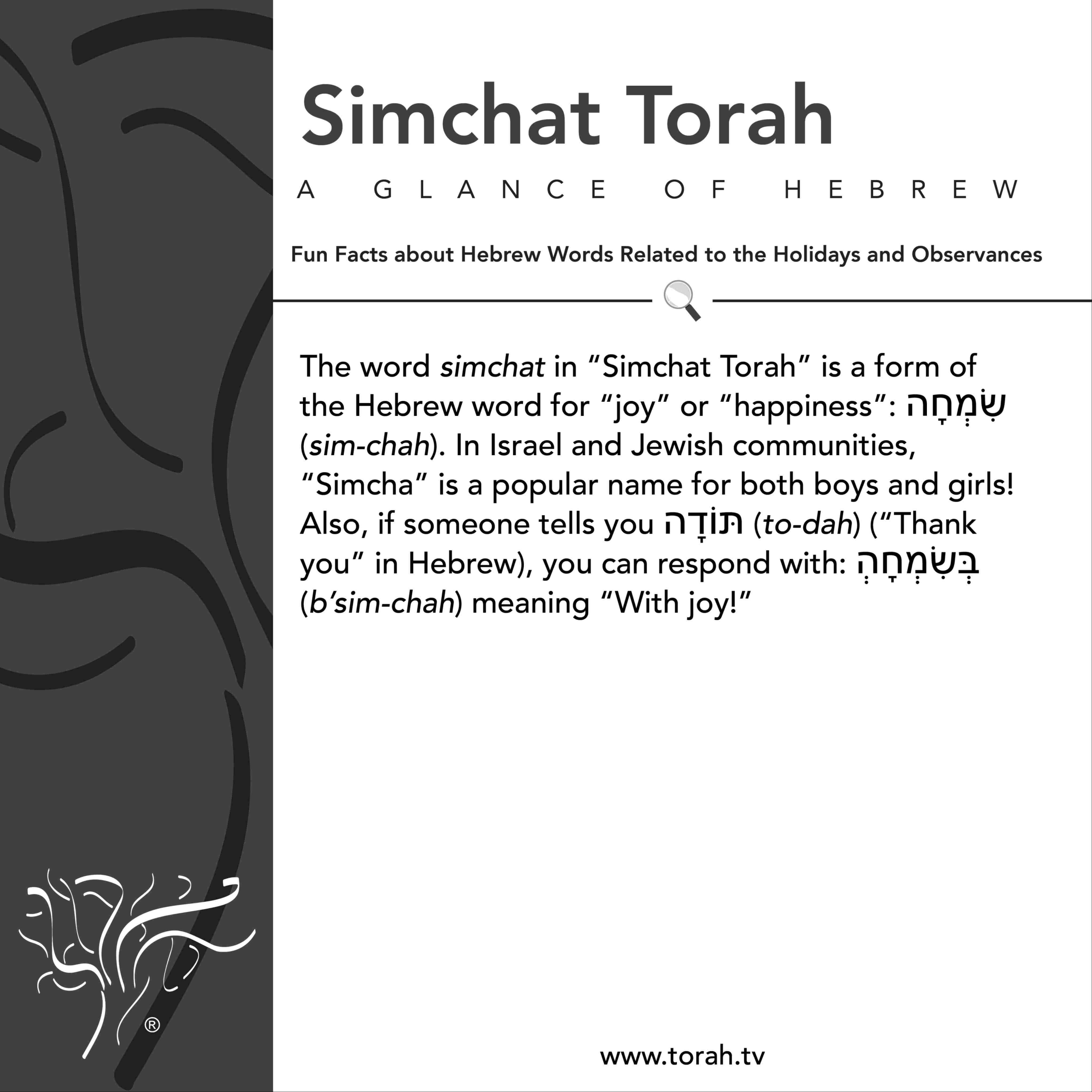
Pronunciation Guide for Transliterated Hebrew Words
| a | [a] as in arm |
| ai | [ai] as in Thailand |
| e | [e] as in red |
| ei | [ei] as in eight |
| i | [i] as in ski |
| o | [o] as in score |
| oi | [oi] as in oil |
| u | [u] as in rule |
| ui | [ui] as in gluing |
| ch/kh | [ch] as in the Scottish loch |
| g | [g] as in good (not as in giant) |
| tz | [ts] as in hats |
| ‘ | short “eh” or “uh” sound |
The Hebrew Scriptures in this text have been derived from the Westminster Leningrad Codex (WLC), and the English translation is based off of the JPS 1917 Tanakh.
Simchat Torah Beit Midrash®
