




Five days after Yom Kippur comes the Festival of Sukkot, one of the Three Pilgrimage Festivals which are known as Shalosh Regalim. (See Lev. 23:33–44 & Exod. 23:14–16.) “Sukkot” means “booths,” referring to the temporary booths that the Children of Israel lived in during their forty-year journey through the desert on the way to the Promised Land.
The Festival of Sukkot, also known as the “Feast of Tabernacles” and the “Time of Our Joy,” is a seven-day celebration. Temporary shelters called sukkot (singular: sukkah) are built and decorated with leaves and fruit. For each of the seven days of this festival, meals are eaten in the sukkah and it is slept in. Dwelling in a sukkah is a reminder of the “Clouds of Glory” which protected the Children of Israel in the wilderness.
The sukkah is symbolic of the chuppah (wedding canopy), as Sukkot is the marriage between the Jewish people and God.
The Festival of Sukkot is also known as the “Festival of Ingathering,” as it was the time when the final harvest was gathered from the field.
Sukkot is a beautiful holiday that reminds us to give thanks for all of the blessings and bounty that God has bestowed upon us, like good health, life, your family and friends, a good night’s sleep, the setbacks in life that have actually made you stronger, a roof over your head, the sound of the rain, having the freedom to take an exhilarating walk or a nice cool swim, food on the table…and fresh, clean water to drink. There are so many reasons to be grateful! It is a great time to start keeping a journal of all that you are thankful for.
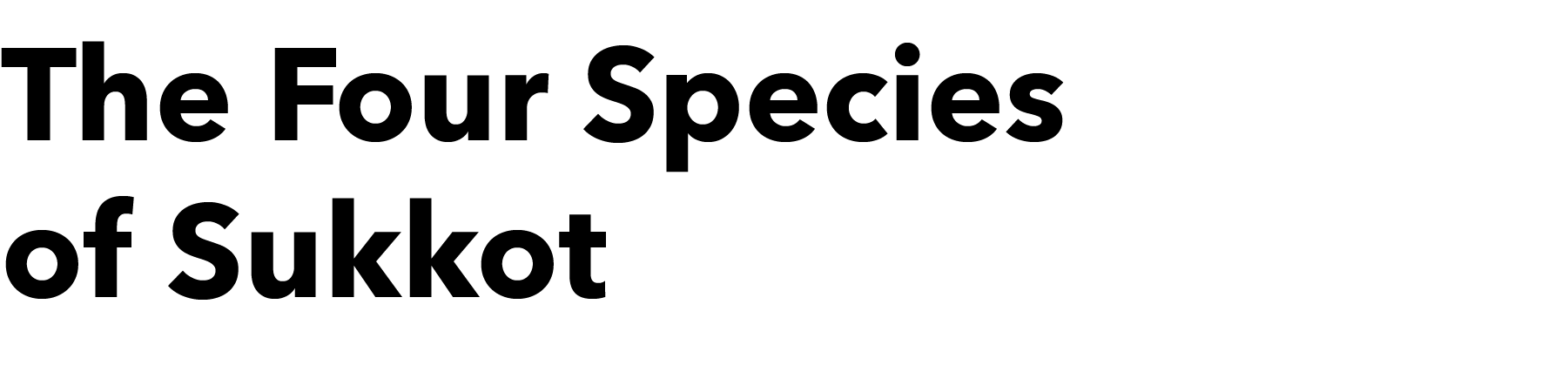
Another observance during Sukkot is to take what is called the “Four Species” (Arba Minim) and “rejoice before the Lord your God for seven days” (Lev. 23:40). The Four Species of Sukkot are:
- etrog – yellow citron
- lulav – palm branch
- three hadassim – myrtle branches
- two aravot – willow branches
Since the lulav (palm branch) is the most distinguished of the four, the Four Species is sometimes referred to as the “lulav” or the “lulav and etrog.” While facing east, the Four Species are held together, a blessing is recited, and the species are waved in six directions (to signify that God is everywhere). When it comes to the sequence in which to wave the Four Species, there are different customs. One custom is to face east and wave the Four Species three times in the following directions: east, south, west, north, up, and down. Another custom is to face east and wave the Four Species three times in the following directions: south, north, east, up, down, and west.

On each day of Sukkot, special prayers called Hoshanot are recited—there are seven in all. “Hoshanot” is derived from the phrase Hosha na, meaning “please bring salvation.” A Torah scroll is taken out of the Ark in the synagogue and brought to the bimah (table in a synagogue from which the Torah is read). One member of the congregation holds the Torah scroll, while the rest of the congregation makes a circle around them while holding the Four Species close to their hearts and reciting the appropriate Hoshana prayer. This encirclement is called hakafah (plural: hakafot). (On Shabbat, these customs vary.)

Sukkot is a seven-day observance which begins on the evening of September 25, 2026, and lasts until the evening of October 2, 2026 (Tishrei 15–21 on the Hebrew calendar).

Traditional greetings for this holiday are: Chag Sukkot Same’ach (Happy Sukkot) and Chag Same’ach (Happy Holiday)!

Be sure to check your STBM emails for news and updates about local Sukkot events. Not getting STBM emails? Sign up for FREE today by CLICKING HERE.
34. …On the fifteenth day of this seventh month is the feast of tabernacles for seven days unto the Lord…. 42. Ye shall dwell in booths seven days; all that are home-born in Israel shall dwell in booths; 43. that your generations may know that I made the children of Israel to dwell in booths, when I brought them out of the land of Egypt: I am the Lord your God.
Pronunciation Guide for Transliterated Hebrew Words
| a | [a] as in arm |
| ai | [ai] as in Thailand |
| e | [e] as in red |
| ei | [ei] as in eight |
| i | [i] as in ski |
| o | [o] as in score |
| oi | [oi] as in oil |
| u | [u] as in rule |
| ui | [ui] as in gluing |
| ch/kh | [ch] as in the Scottish loch |
| g | [g] as in good (not as in giant) |
| tz | [ts] as in hats |
| ‘ | short “eh” or “uh” sound |
The Hebrew Scriptures in this text have been derived from the Westminster Leningrad Codex (WLC), and the English translation is based off of the JPS 1917 Tanakh.
Simchat Torah Beit Midrash®
